LAUREL PARK 150th anniversary
11 a.m. Saturday Oct. 22
The Tabernacle
Greetings and acknowledge the committee that organized this 150th anniversary celebration.
In preparing my remarks, I viewed replicas of the six historical signs on exhibit at Forbes Library this month. As I was leaving, I noticed on a table beneath a poster with details of today’s celebration a small glass bowl filled with small slips of paper. Thinking they might be inspirational quotes from speakers here during the past 150 years. I took one and found directions to Laurel Park. I thought it odd to have to provide direction to a place that has stood for 150 years and that early in its history was a regional hub drawing thousands of people each day to summer Methodist camp meetings and Chautauqua Assemblies. That reinforced my sense that Laurel Park is one of those hidden gems in Northampton with a rich history that not only needs preservation but also deserves greater recognition. A modest public-private partnership involving the city and Laurel Park Association has a huge payoff in making the park’s history more accessible
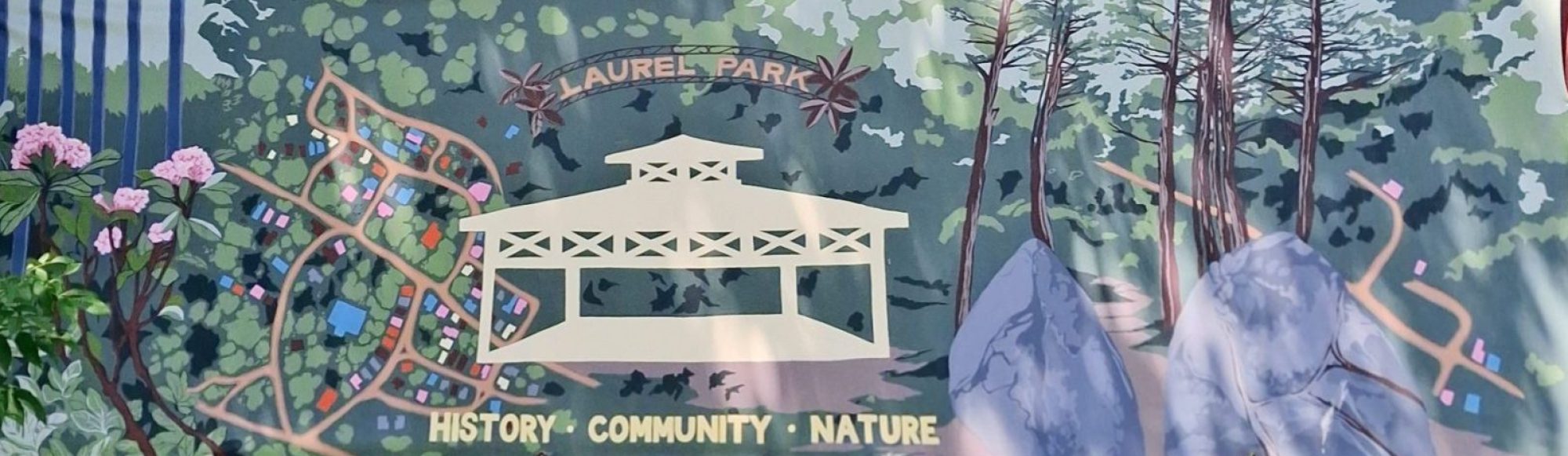
Earlier this year, the city approved using $3,000 of Community Preservation Act money to pay approximately half the cost of producing the six historical signs that are now placed at the park’s common buildings. Acknowledge researchers Sandra Matthews & Cindy Joy; they and Liz Duffy Adams & Laura Pravitz wrote the text; and Kandy Littrell designed the signs. They did a terrific job combining text and archival photos to provide a powerful sense of this place, not just its evolution to the community it is today with 150 residents and 100 buildings, but also its significance as part of an American movement, particularly during its first 50 years.
What started 150 years ago as a place for “spiritual awakening” at Camp Meetings in tents, by 1887 added the Chautauqua Assemblies that included cultural and educational activities. In 1878 the first wooden structure – an earlier version of this Tabernacle – was built on the grounds. Three trains a day in each direction stopped at a nearby station of the Connecticut River Railway, and trolleys arrived every 20 minutes from downtown Northampton bringing people to the assemblies. Traveling performers presented up to three shows a day: popular music, theater, political oratory and debate. One observer in the early 1900s described it as the “best talent the country produces brought to Laurel Park.” The assemblies provided thousands of people with access to cultural and educational programs that otherwise would have been out of their reach.
We are fortunate in Northampton to have places that celebrate history specific to our local community as well as that which was impactful on the bigger national stage. I think of Historic Northampton, the Calvin Coolidge Presidential Library and Museum at Forbes Library, the Sojourner Truth statue and David Ruggles Center. And today we recognize another one of those places in celebrating Laurel Park’s first 150 years and its significant history that is instructive and inspirational as we look to the future.
—
Stanley Moulton